

Fundraising Team Leadership, Culture & Operating Model Assessment

Document control & use
| Field | Detail |
|---|---|
| Document title | Fundraising Team Leadership, Culture & Operating Model Assessment |
| Version | 1.0 - Executive issue |
| Prepared by | Office of the Managing Director, Veltrion Group Pty Ltd |
| Commissioned by | Ayden Hernan-Sayers, Managing Director |
| Classification | Private & Confidential - Internal Management Use Only |
| Primary audience | Managing Director; Director / Head of Fundraising; nominated senior team members |
| Source material | Conversation notes with Courtney Carter and Nyenpiu Mayor dated 16 July 2026; screenshot of Courtney Carter's work history supplied by management |
| Approval status | Draft for leadership discussion and action planning |
Purpose
The report converts qualitative conversations into a structured executive assessment of team health, leadership, operational maturity and immediate management priorities. It also identifies the potential strategic value of Courtney Carter's prior management experience to Veltrion's future operating model.
Confidentiality
Distribution should be limited to persons with a legitimate management need to know. Direct quotations and interpersonal observations should be discussed sensitively and should not be circulated more broadly without a clear business purpose.
Table of contents
A high-potential team constrained by inconsistent systems
The two conversations independently point to the same central conclusion: Veltrion's fundraising team retains ambition and capability, but the current operating environment lacks enough structure, role clarity and leadership consistency to convert that potential into repeatable performance.
What the evidence indicates
Strengths to preserve
- Both employees believe the team wants to win.
- Byron is regarded as supportive, constructive and capable.
- The team is seen as having substantial potential.
- There is willingness to provide candid feedback and improve.
Problems to address
- Daily structure, rotations and transport are inconsistent.
- Friendship and management boundaries are blurred.
- Leadership decisions appear vulnerable to self-doubt and competing opinions.
- Time management, accountability and team connection have weakened.
Executive recommendation
Do not treat the current issues as evidence that the team requires wholesale replacement. Treat them as a management-system reset: establish clear authority, a documented daily operating rhythm, fair rotations, realistic targets, professional boundaries, and a formal pathway for high-capability employees to contribute beyond frontline fundraising.
Organisational health scorecard
Indicative scores reflect the qualitative evidence available, not a statistically validated employee survey.
Management interpretation
Green
Capability and aspiration
The team believes it can perform and recognises Byron's strengths.
Amber
Motivation and connection
Recoverable, but vulnerable to continued inconsistency.
Red
Structure and boundaries
Immediate intervention is warranted.
Scope, methodology and evidence limitations
Inputs reviewed
- Management notes from Ayden Hernan-Sayers' discussion with Nyenpiu Mayor dated 16 July 2026.
- Management notes from Ayden Hernan-Sayers' discussion with Courtney Carter dated 16 July 2026.
- Screenshot of Courtney Carter's work history, including roles in medical reception, second-in-charge, practice management and multi-site business management.
Assessment approach
1. Extract
Every substantive observation in the notes was captured and grouped.
2. Corroborate
Independently repeated themes were given greater weight.
3. Translate
Observations were converted into risks, causes and practical management actions.
Evidence boundaries
The report does not independently verify the truth of interpersonal events. Some comments are subjective impressions, including statements about genuineness, breaks, ego, following behaviour, and whether targets were realistic. These matters should be approached as signals requiring clarification, not proven findings.
Confidence levels
| Confidence | Meaning | Examples in this review |
|---|---|---|
| High | Theme independently reflected by both interviews | Need for structure; reduced cohesion; leadership confidence; desire to succeed |
| Moderate | Detailed observation from one interview that is operationally plausible | Transport planning; Courtney being treated as the team's Uber; time management concerns |
| Low / unverified | Interpersonal impression or allegation requiring direct verification | Ritchie appearing inauthentic; following Courtney home; frequency and purpose of breaks |
Mayor's perspective: structure, fairness and visible leadership
Mayor's comments suggest uncertainty about what has been occurring across the team, alongside a view that standards and motivation softened while Ayden was in Melbourne.
Positive observations
- She likes the people in the team.
- Mary and Mayor work very well together.
- Byron provides constructive feedback and checks in regularly in a positive way.
- Byron's training style is considered good.
- She believes everybody wants to win.
Concerns raised
- She was unsure what had been happening with the team and felt uninformed.
- A degree of tardiness began when Ayden travelled to Melbourne.
- Motivation may have reduced.
- Rotations and booth time were perceived as insufficiently structured or equal.
- The team was becoming disconnected.
Lead-from-the-front expectation
Mayor described some unit-based requests as unrealistic or disconnected. A specific example was a request to achieve 150 units in a day. She did not believe that target was realistic; however, she said she would have been more motivated to push toward it if she had seen Byron demonstrate that the result was possible.
Implication
High expectations are not inherently demotivating. They become demotivating when employees cannot see the operating logic, evidence or leader behaviour that makes the target credible. Target setting should therefore be supported by historical data, clear conversion assumptions and visible coaching.
Courtney's perspective: consistency, authority and professional separation
Courtney's feedback is more detailed and operationally focused. She appears frustrated by conflicting messages, unclear authority and a workplace where friendship, transport, external involvement and management responsibility have become intertwined.
Core themes
Authority & consistency
- She does not always know what to believe, particularly between Jay and Byron.
- She needs to see Byron as her boss during work hours and friend only after work.
- She believes Byron should treat her as an employee at work rather than primarily as a friend.
- She wants more direct instruction rather than open-ended questions about what may work.
Operating discipline
- Booths must be properly set up and coordinated.
- Plans should be effective and achievable.
- Ubers should be booked the night before.
- Starting the day on the back foot damages the rest of the day.
- It is not Courtney's responsibility to be everyone's Uber.
Management style
Courtney considers Byron very good at his job but believes he may become overly involved in every task. Her interpretation is that he doubts whether he is being a sufficiently supportive manager and consequently over-corrects, second-guesses himself and can negatively affect both his own confidence and the team's confidence.
Time and responsibility
- Courtney feels pulled into matters that may not concern her role.
- She questioned whether simple tasks, such as sending an email, should take an hour.
- She believes poor attendance or effort from others can spread across the team and affect her own standards.
- She believes too many people who are not employed by Veltrion are involved in team matters.
Interpersonal and boundary observations
Friendship and work boundaries
Courtney believes professional and outside-work friendships are blurred and no longer appropriately separated. She described a perceived breach of boundaries when she felt Amber and Byron followed her and Jay in a car back to Courtney's house. Regardless of intention, the perception itself indicates that personal space and professional roles require clearer boundaries.
Jay and Byron
Courtney felt Jay was unable to separate Byron's role as someone present to help from the idea that Byron was taking over. She described too much ego within the broader situation. This indicates an unresolved authority and communication issue: who is accountable, who is assisting, and how changes in control are communicated.
Ritchie
Courtney questioned whether Ritchie was genuine or presenting a facade. She described an incident in which he followed her to obtain ice cream after she went off-the-mark, paid for the ice creams and then became passive when he could not eat his. This is an interpersonal perception rather than a management finding, but it is recorded here to ensure no source observation is omitted.
Mayor's breaks
Courtney stated that Mayor takes breaks “all the time” and questioned whether non-booth time was being used for work-related purposes. This conflicts somewhat with Mayor's own focus on fairness and requires objective observation rather than assumption. A formal rotation and activity record would allow management to address the issue factually.
Overall sentiment
Despite her concerns, Courtney believes the team has “MASSIVE potential”. Her comments are not a rejection of the team or Byron; they are a request for clearer leadership, stronger systems and more direct management.
Six recurring themes explain most of the dysfunction
| Theme | Evidence | Likely root cause | Management implication |
|---|---|---|---|
| Structure | Rotations, booth time, Ubers, setup and daily plans | Reliance on informal coordination | Create standard daily operating procedures |
| Authority | Conflicting messages; Jay / Byron tension; friend versus boss | Decision rights not explicit | Publish reporting lines and escalation paths |
| Leadership confidence | Second-guessing; seeking opinions; over-correction | High care, low confidence in mandate | Coach Byron to decide, explain and hold the line |
| Fairness | Unequal booth time; break perceptions | No transparent rotation record | Use pre-set rotations and time tracking |
| Boundaries | Friendships, home incident, non-employees, transport dependence | Social relationships merged with work systems | Adopt conduct and boundary expectations |
| Connection | Team becoming disconnected; lower motivation | Inconsistent leadership rhythm and shared goals | Rebuild cadence, recognition and common purpose |
Root cause chain
Team expands through relationships
Roles, transport and rotations remain ad hoc
More checking, more opinions, less certainty
Motivation, punctuality and trust decline
Central diagnosis
Veltrion's fundraising team has outgrown an informal, friendship-led management model. The next stage requires an explicit operating model: named authority, published routines, objective measures and boundaries that preserve relationships without allowing them to substitute for management.
Leadership profile: strong coach, inconsistent authority
The available feedback is broadly favourable toward Byron's capability and intent. The key development requirement is not technical competence; it is confident execution of management authority.
What Byron should retain
What Byron should change immediately
- State the decision, the reason and the expected result.
- Stop seeking consensus where management judgement is required.
- Delegate defined tasks and review outcomes rather than monitoring every action.
- Separate social friendship from workplace direction.
- Demonstrate or evidence challenging performance targets.
A practical management cadence for Byron
Before the day
- Confirm location, transport and arrival time.
- Publish booth rotation and breaks.
- Set individual and team targets with rationale.
- Assign setup, stock and administration owners.
Start of day
- Ten-minute briefing.
- State expected behaviours and priorities.
- Confirm escalation and support arrangements.
- Resolve ambiguity before field activity begins.
During the day
- Observe performance at set intervals.
- Coach one issue at a time.
- Avoid constant task switching and public second-guessing.
- Lead from the front where credibility is needed.
End of day
- Record results, hours and exceptions.
- Recognise wins and identify one improvement.
- Confirm the next day's logistics.
- Escalate recurring conduct or performance issues formally.
Decision-rights model
| Decision | Owner | Consulted | Escalation |
|---|---|---|---|
| Daily location, rotations and transport | Byron / nominated team lead | Relevant fundraiser input where practical | Ayden for material cost or client issue |
| Performance targets | Byron | Ayden; campaign data | Ayden where target materially changes remuneration or campaign expectation |
| Conduct and attendance response | Byron documents; Ayden decides formal action | Employee concerned | External HR/legal advice where necessary |
| Operational process improvements | Assigned operations owner | Team | Ayden for policy or expenditure approval |
Rebuild connection without allowing friendship to govern work
Managing Director
Strategy, governance, escalation
Director / fundraising leadership
Daily authority and coaching
Courtney, Mayor, Mary and others
Defined duties and performance standards
No operational authority unless formally authorised
Required cultural standards
At work
- Role authority is respected.
- Instructions are direct and consistent.
- Transport is a business arrangement, not a personal obligation.
- Breaks and booth time are transparent.
- Concerns are raised through defined channels.
Outside work
- Friendships remain voluntary and respectful.
- No employee should feel followed, pressured or monitored socially.
- Work disputes are not continued at private homes.
- Personal relationships do not alter standards or opportunities.
- Non-employees do not intervene in management matters.
Team charter statement
We arrive prepared, communicate directly, respect the role of the leader, compete professionally, share booth time fairly, protect personal boundaries and take collective responsibility for the team's result.
Operational controls required immediately
| Control | Current signal | Required standard | Evidence retained |
|---|---|---|---|
| Attendance | Tardiness reportedly increased | Start time, arrival time and reason for exception recorded | Daily attendance sheet |
| Booth rotation | Perceived inequality | Published sequence with equal opportunity, adjusted only for business need | Rotation roster |
| Breaks | Competing perceptions about frequency | Defined entitlements and timing | Roster / supervisor notes |
| Transport | Late Ubers; reliance on Courtney | Booked the prior evening; approved exceptions only | Booking confirmation |
| Targets | Some requests perceived as unrealistic | Evidence-based target with unit economics and examples | Daily target sheet |
| Off-booth activity | Unclear whether time is work-related | Specified duties such as breaks, lead follow-up, stock or admin | Activity record |
| External involvement | Too many non-employees involved | Operational access only where authorised | Role / access register |
Daily one-page operating sheet
Logistics
Venue, pickup, arrival, setup and departure.
People
Leader, booth order, breaks and responsibilities.
Performance
Targets, units, conversions and coaching focus.
Exceptions
Lateness, incidents, client issues and follow-up.
SWOT analysis
Strengths
- Team members express desire to win.
- Byron is viewed as capable, constructive and a good trainer.
- Strong interpersonal familiarity can support trust when boundaries are clear.
- Courtney brings substantial prior management experience.
Weaknesses
- Informal daily planning and unclear decision rights.
- Blurred friendships and professional roles.
- Perceived unfairness in booth time and breaks.
- Leader self-doubt and over-involvement.
Opportunities
- Create a scalable field operations model.
- Develop Byron into a stronger people leader.
- Use Courtney in an operations or team-lead pathway.
- Improve retention and results through transparent systems.
Threats
- Loss of high-potential employees.
- Escalating interpersonal disputes.
- Client dissatisfaction arising from poor punctuality or setup.
- Workplace conduct, safety or boundary complaints.
Strategic conclusion
The largest opportunity is to turn a relationship-driven group into a professionally managed field force without losing its energy and loyalty. That requires systems that are proportionate, clear and consistently applied.
Risk heat map
Priority risks
| Risk | Rating | Control response | Owner |
|---|---|---|---|
| Leadership inconsistency reduces trust and performance | Critical | Explicit authority, coaching, weekly MD review | Ayden / Byron |
| Professional boundaries generate complaint or harm | Critical | Boundary standard, no home follow-up, escalation path | Ayden |
| Transport and setup failures affect client delivery | High | Prior-night booking and daily operating sheet | Byron / team lead |
| Perceived unfairness damages morale | High | Published rotation and break system | Byron |
| High-capability employee leaves or disengages | High | Career discussion, role design, regular feedback | Ayden |
Risk treatment plan
| Action | Timing | Success indicator |
|---|---|---|
| Hold a private leadership reset meeting with Byron | Within 48 hours | Written authority, expectations and weekly cadence agreed |
| Issue an interim daily field operations template | Within 3 business days | Every field day has a roster, transport and target plan |
| Clarify workplace and after-hours boundaries | Within 7 days | Team understands conduct expectations and reporting path |
| Conduct individual check-ins with Courtney and Mayor | Within 7 days | Feedback acknowledged; expectations clarified; no retaliation |
| Verify interpersonal allegations before any action | As required | Contemporaneous notes and both sides heard |
| Review the model after four weeks | Day 30 | Improvement in punctuality, rotation fairness and reported clarity |
What not to do
Avoid public blame
Do not circulate interview notes or identify one employee as the cause of the team's issues.
Avoid instant promotion
Do not assume management experience alone guarantees fit; assess interest, conduct and performance.
Avoid over-engineering
Do not create burdensome policies where a one-page operating sheet will solve the problem.
Avoid informal investigations
Do not treat hearsay as established fact or discuss sensitive matters socially.
Courtney's work history indicates substantial untapped operating capability
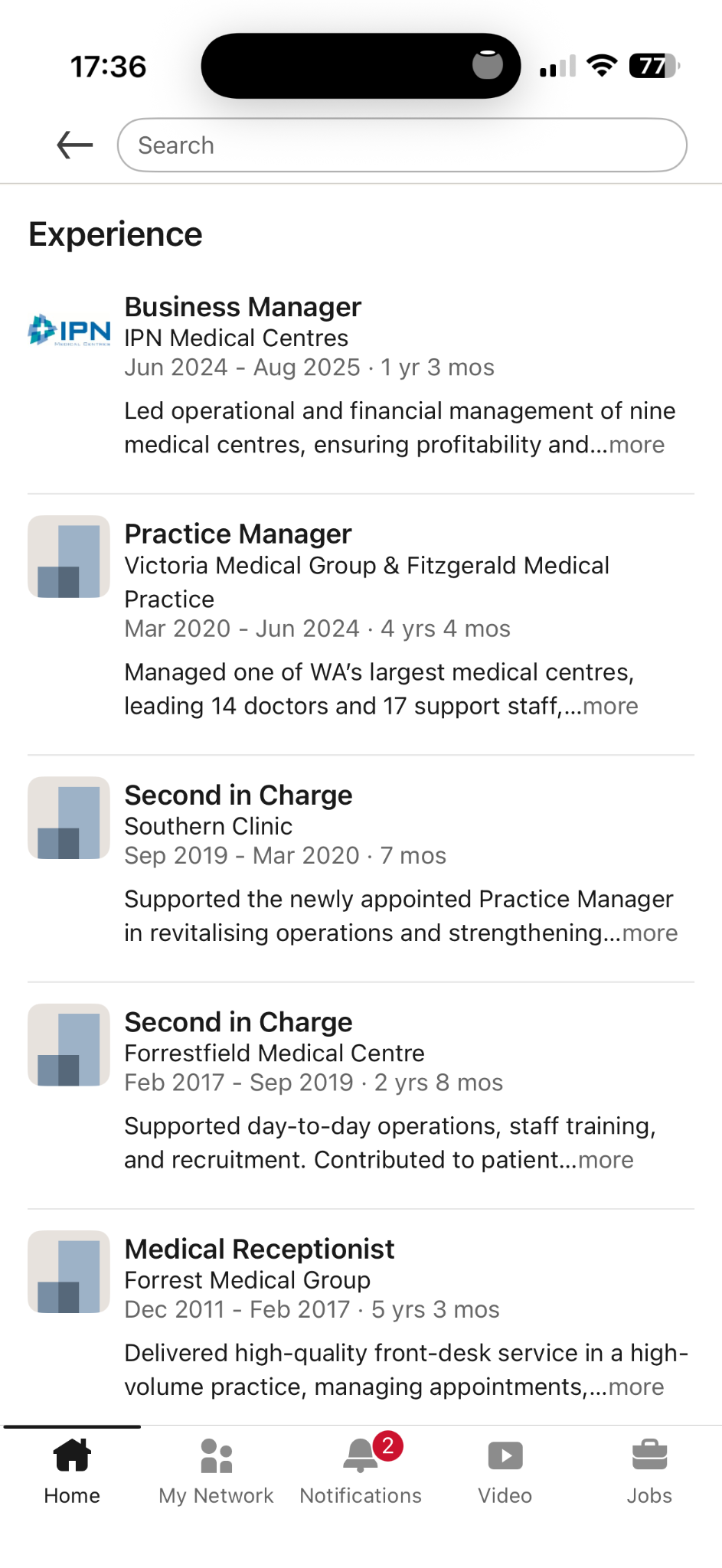
Jun 2024 - Aug 2025 | 1 year 3 months
Led operational and financial management of nine medical centres, including profitability responsibilities.
Mar 2020 - Jun 2024 | 4 years 4 months
Managed one of Western Australia's largest medical centres, leading 14 doctors and 17 support staff.
Sep 2019 - Mar 2020 | 7 months
Supported a newly appointed Practice Manager in revitalising operations and strengthening the practice.
Feb 2017 - Sep 2019 | 2 years 8 months
Supported day-to-day operations, staff training and recruitment.
Dec 2011 - Feb 2017 | 5 years 3 months
Delivered high-volume front-desk service, appointment administration and patient-facing coordination.
Potential role pathways for Courtney
Courtney should not be viewed only through the lens of current fundraising output. Her career indicates experience in multi-site operations, staff leadership, financial oversight, recruitment, service delivery and process improvement.
| Potential pathway | Possible scope | Fit rationale | Suggested first step |
|---|---|---|---|
| Senior Fundraiser / Team Lead | Daily roster, booth setup, onboarding and on-field support | Immediate use of leadership capability without removing her from revenue activity | Four-week acting assignment |
| Fundraising Operations Coordinator | Transport, rosters, compliance, stock, reporting and team administration | Directly addresses the gaps raised in both interviews | Define 8-12 hours weekly operations allocation |
| People & Operations Manager | Recruitment, onboarding, performance systems and operational standards | Strong alignment with previous practice management | Assess interest, remuneration and authority |
| Business Operations Manager | Cross-business processes, KPIs, budgets and delivery governance | Potential longer-term application of multi-site business management experience | Capability interview and staged development plan |
Recommended approach
- Ask Courtney about her career goals and why she moved from medical management into fundraising.
- Determine whether she wants responsibility, stability and progression within Veltrion.
- Do not create a title without authority, defined outcomes and appropriate remuneration.
- Use a time-limited acting assignment to test fit and working relationships.
- Ensure Byron understands whether Courtney is supporting his function or reporting separately to Ayden.
Strategic recommendations
| # | Recommendation | Why it matters | Timing |
|---|---|---|---|
| 1 | Formalise Byron's day-to-day authority | Ends conflicting messages and reinforces accountability | Immediate |
| 2 | Introduce a one-page daily field plan | Fixes transport, setup, rotation, breaks and target clarity | Immediate |
| 3 | Publish professional boundary expectations | Protects employees and the company | 7 days |
| 4 | Implement evidence-based targets | Improves credibility and motivation | 14 days |
| 5 | Hold weekly Ayden / Byron leadership meetings | Builds Byron's confidence without undermining his authority | Weekly |
| 6 | Create a transparent rotation and break system | Removes perceptions of favouritism and inactivity | 3 days |
| 7 | Restrict non-employee operational involvement | Clarifies accountability and confidentiality | Immediate |
| 8 | Explore Courtney's operating role through a trial | Uses existing capability to solve current gaps | 30 days |
| 9 | Run a short monthly culture pulse | Detects issues before they become resignations or conflict | Monthly |
| 10 | Document a scalable field operations manual | Allows growth beyond individual personalities | 90 days |
Immediate meeting message
“The purpose of this review is not to assign blame. It is to acknowledge that the team has outgrown informal practices. We are going to keep what works - the energy, coaching and ambition - while introducing the structure, authority and boundaries expected of a professional fundraising business.”
Transformation roadmap
Stabilise
- Leadership reset with Byron
- Daily field plan launched
- Transport booked prior evening
- Rotations and breaks published
- Boundary expectations issued
- Individual check-ins completed
Strengthen
- KPI dashboard implemented
- Byron leadership coaching
- Courtney acting-role trial considered
- Target methodology documented
- Team charter adopted
- First culture pulse completed
Scale
- Field operations manual finalised
- Role pathways and succession plan
- Client service controls reviewed
- Performance trends assessed
- Policies refined from evidence
- Executive review and next-quarter plan
Milestone gates
| Gate | Question | Proceed when |
|---|---|---|
| Day 14 | Are logistics and authority clearer? | No recurring confusion about Ubers, rotations or daily ownership |
| Day 30 | Has punctuality and fairness improved? | Records show sustained adherence and employee feedback improves |
| Day 60 | Is Byron leading with confidence? | Fewer reversals, clearer delegation and credible targets |
| Day 90 | Can the model support growth? | Processes operate without Ayden resolving routine daily issues |
Implementation ownership
| Workstream | Accountable | Responsible | Consulted | Informed |
|---|---|---|---|---|
| Leadership reset | Ayden | Ayden / Byron | External HR adviser if needed | Relevant team members |
| Daily field plan | Byron | Byron / nominated coordinator | Courtney, Mayor and team | Ayden |
| Boundary standard | Ayden | Management | Employees | All relevant personnel |
| KPI dashboard | Ayden | Operations owner | Byron | Leadership team |
| Courtney pathway | Ayden | Ayden / Courtney | Byron | Only those affected |
| Operations manual | Ayden | Operations owner | Fundraising team | All field staff |
Meeting sequence for tonight
- Open with purpose: explain that the goal is improvement, not blame.
- Recognise strengths: Byron's coaching, Courtney's capability and the team's ambition.
- State the diagnosis: the team has outgrown informal practices.
- Confirm immediate rules: authority, transport, rotations, breaks and boundaries.
- Invite factual correction: allow Byron and Courtney to identify inaccuracies.
- Agree actions: record owners and dates before ending the meeting.
- Follow up privately: sensitive interpersonal matters should not be debated in a group setting.
KPI dashboard and success measures
| Category | KPI | Initial target | Review frequency |
|---|---|---|---|
| Attendance | On-time arrival rate | ≥ 95% | Weekly |
| Planning | Field plans completed before prior evening cut-off | 100% | Weekly |
| Fairness | Rotation adherence | ≥ 95% | Weekly |
| Performance | Units / hour and conversion rate | Baseline then improvement target | Daily / weekly |
| Quality | Valid sign-up / retention quality | Campaign-specific | Monthly |
| Leadership | Employees reporting clear direction | ≥ 8 / 10 | Monthly pulse |
| Culture | Employees reporting fair treatment | ≥ 8 / 10 | Monthly pulse |
| Boundaries | Unresolved conduct or boundary concerns | 0 overdue matters | Monthly |
Five-question monthly pulse
- I understand who is responsible for decisions during field operations.
- Booth time, breaks and transport are managed fairly.
- I receive clear and useful feedback.
- Professional and personal boundaries are respected.
- I believe this team can succeed together.
Use a 1-10 scale plus one optional free-text question: “What is the single change that would most improve next month?”
Leadership and governance cadence
Daily
Ten-minute briefing, written field plan, end-of-day result and exception record.
Weekly
Ayden / Byron review of people, campaign performance, risks and next-week logistics.
Monthly
Culture pulse, KPI trend review, recognition, process improvement and staffing plan.
Standing weekly agenda
| Item | Time | Output |
|---|---|---|
| Campaign results and quality | 10 min | Trend and corrective action |
| People and attendance | 10 min | Coaching, recognition or formal follow-up |
| Operations and logistics | 10 min | Confirmed venues, transport and rosters |
| Leadership decisions | 10 min | Decisions recorded with owner and date |
| Risks and escalations | 5 min | Risk owner and treatment |
Expected outcome
Within 90 days, routine field operations should be managed without repeated intervention from the Managing Director, while Byron retains clear authority and receives structured executive support rather than ad hoc correction.
Nyenpiu Mayor - complete observations captured
- Unsure what has been happening with the team and does not know anything.
- A little tardiness started happening when Ayden went to Melbourne.
- She loves everybody.
- There may be a lack of motivation.
- She functions better under a formal structure.
- Rotations need to be properly structured.
- There is perceived inequality in booth time.
- Mary and Mayor work really well together.
- Courtney and Byron tend to come back later than normal.
- Byron is on the ball with constructive feedback.
- Byron checks in regularly in a good way.
- Byron's training style is good.
- It would be good if Byron could lead from the front.
- Some unit-based requests seem unrealistic or disconnected.
- Mayor was asked to achieve 150 units for a particular day and did not believe that was realistic.
- She would have been more motivated to try and achieve the target if she saw it was possible from Byron.
- She feels the team is becoming disconnected and not connecting properly.
- “Everybody wants to win.”
Courtney Carter - complete observations captured
- She is frustrated by significant inconsistency and not knowing what to believe, specifically between Jay and Byron.
- She needs to see Byron as her boss, not her friend, during work hours; the same separation is required from Byron.
- There needs to be structure.
- If others are not “showing up”, it affects the entire team, including Courtney.
- Too many people not employed within Veltrion are involved.
- Time management is a major issue.
- She gets pulled into matters that may have nothing to do with her.
- She questioned taking an hour to send one email.
- There may be some micromanagement.
- Byron is great at his job and does not need to concern himself with every task everyone is doing at once.
- Her professional interpretation is that Byron may feel he is not being a good manager or supporting subordinates properly, so he over-corrects or doubts himself too much.
- This negatively affects both himself and members of the team.
- Structure is key.
- Booths must be set up and coordinated properly.
- Plans should be effective and achievable.
- Ubers should be booked the night before.
- Starting the day on the back foot makes the day worse.
- It is not Courtney's responsibility to be everyone's Uber.
Courtney Carter - complete observations continued
- Jay was not able to separate the fact that Byron was there to help, not take over.
- There is too much ego involved.
- Courtney questioned whether Ritchie was genuine or putting on a facade.
- She described Ritchie following her to get ice cream after she went off-the-mark.
- Ritchie paid for the ice creams and then, when he could not eat his, became passive and Courtney felt blamed.
- Mayor takes breaks “all the time”.
- Courtney questioned whether Mayor does anything work-related during off-booth time.
- Professional and outside-work friendships are blurred and no longer separated.
- Courtney felt a clear breach occurred when she believed Amber and Byron followed her and Jay in a car back to Courtney's house.
- She felt friendship and professional boundaries were ignored or blurred.
- The team has “MASSIVE potential”.
- Comments should be more direct: if something is not working, do not ask what “might work”; give a clear direction.
- Her advice to Byron is to back himself.
- She believes Byron relies too much on everyone else's opinions.
- Byron should trust himself regarding what he wants for the team.
Proposed Veltrion fundraising team charter
We prepare
We confirm transport, equipment, location, targets and responsibilities before the working day begins.
We are accountable
We arrive on time, use booth and break time appropriately, and record exceptions honestly.
We communicate directly
Managers provide clear direction; employees raise concerns respectfully and through the right channel.
We respect roles
Friendship does not remove authority, and authority does not justify disrespect.
We compete professionally
We pursue ambitious results while protecting quality, compliance and team fairness.
We protect boundaries
We respect personal time, private homes and voluntary social relationships.
Leadership acknowledgement
| Ayden Hernan-Sayers Managing Director | Byron Rix Director / Head of Fundraising |
| Date: | Date: |
Team acknowledgement
Acknowledgement confirms receipt and understanding. It should not be presented as a waiver of legal rights.
| Name | Signature | Date |
|---|---|---|
The opportunity is to professionalise without losing the team's ambition
The interviews do not describe a team that has given up. They describe a team asking for leadership clarity, fair systems, direct communication and a more professional separation between work and friendship.
Final assessment
Byron should be supported to become a more decisive leader, not displaced by the feedback. Courtney should be assessed as a potential operating asset, not confined to her present role or promoted without due process. Mayor's concern about fairness should be addressed through objective systems rather than competing narratives. The interpersonal issues should be handled carefully, privately and factually.
Board-level takeaway
Veltrion has reached the point where informal practices create material people and delivery risk. A focused 90-day operating-model reset is likely to produce a disproportionate improvement in morale, accountability and fundraising performance.
Prepared for Veltrion Group Pty Ltd
Majority owned by Hernan Sayers Group Pty Limited